0.1 miles away
Kitt Peak National Observatory
An observatory west of Tucson holding more than twenty optical telescopes, one of the largest such gatherings in the northern hemisphere.
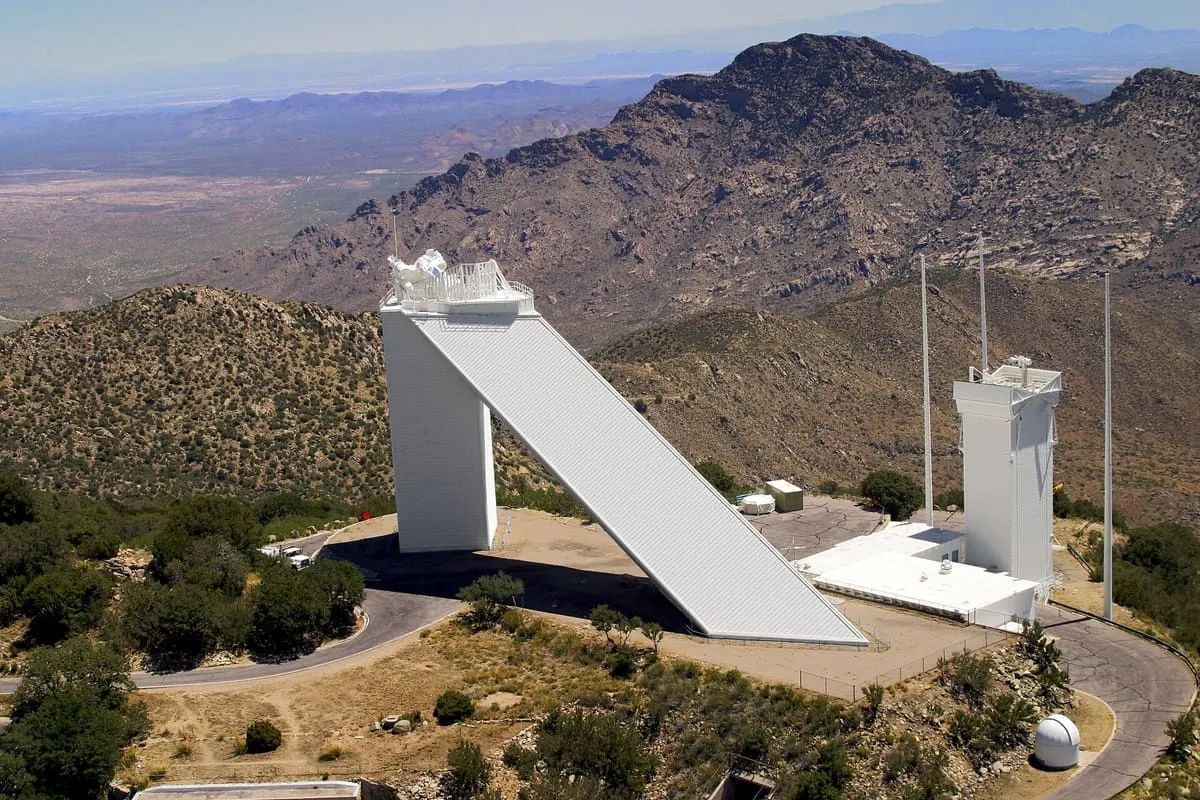
A 1.6-metre solar telescope of 1962 at Kitt Peak, once the largest solar telescope and the largest unobstructed-aperture optical telescope in the world.
The McMath–Pierce solar telescope is a 1.6-metre f/54 reflecting solar telescope at Kitt Peak National Observatory in Arizona. Built in 1962, it was the largest solar telescope and the largest unobstructed-aperture optical telescope in the world. The building was designed by the American architect Myron Goldsmith and the Bangladeshi-American structural engineer Fazlur Rahman Khan. Originally called the McMath Solar Telescope, it was renamed in 1992 after the astronomers Robert Raynolds McMath and Keith Pierce. Although designed for observation of the Sun, it can also be used to view bright objects at night. In 2018 the telescope received a grant of $4.5 million for an enhanced visitor centre and other programmes.
McMath–Pierce Solar Telescope is a observatory near Altar Valley, in Pima County. It is one of the observatories in this database, and appears in the statewide ranking of Arizona attractions.
No official visitor count is published for McMath–Pierce Solar Telescope, so its score rests on public interest and tourism significance, and is capped below the level a measured attraction can reach. That is why the medium confidence above is not higher. The weighting is explained in full on the methodology page, and every axis is broken out under Facts and sources at the foot of this page.
Note on the data: No official visitor count is published for this attraction.
Record last verified 2026-08-12.

0.1 miles away

0.5 miles away

12 miles away
24 miles away

32 miles away